
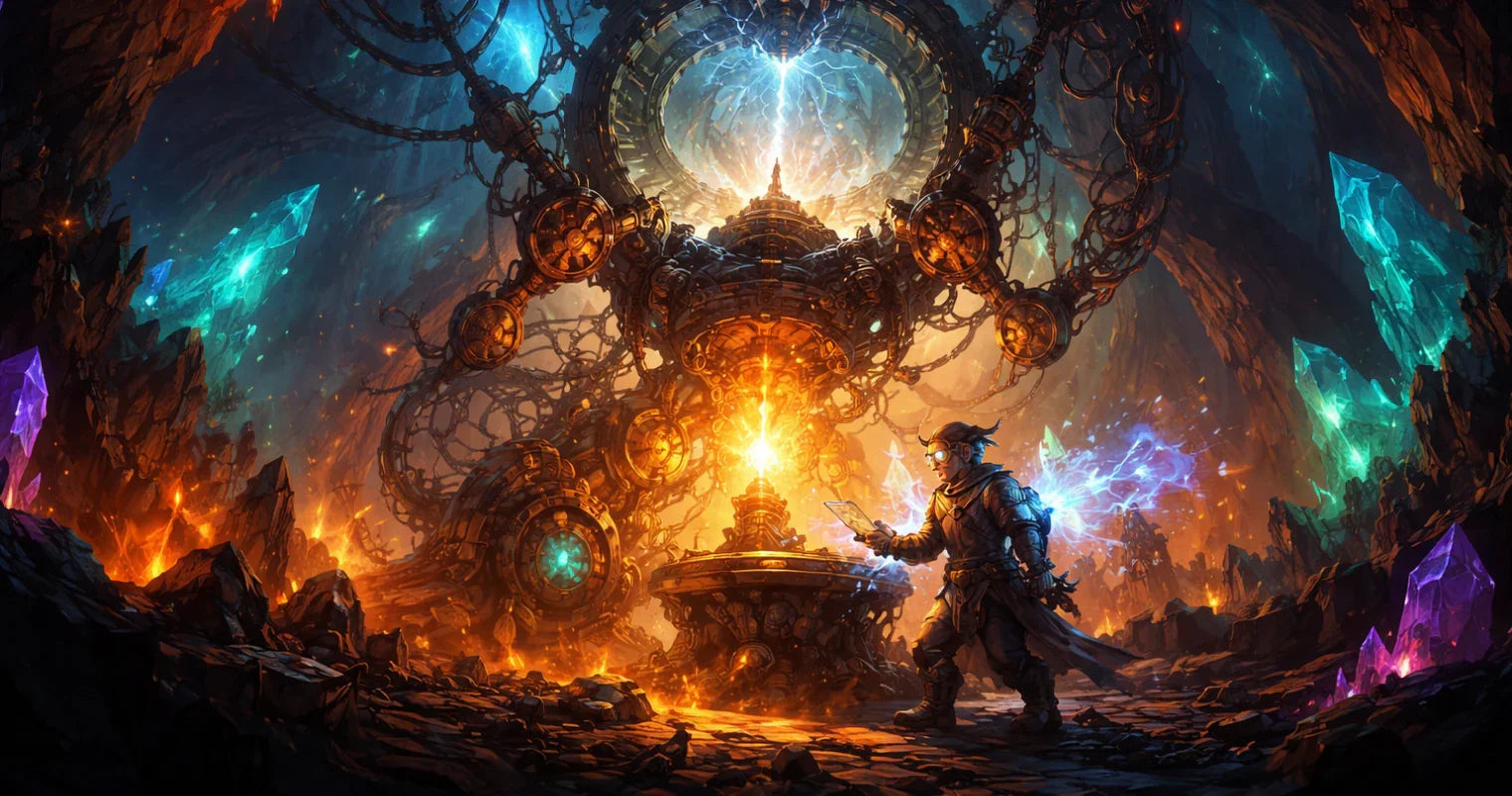
Eberron Forge of the Artificer updates for players
Eberron has always treated magic as something people build with, travel through, fight over, and depend on. Airships cross the skies, lightning rails connect distant cities, magical industries shape economies, and the Last War still influences the lives of adventurers across Khorvaire.
Eberron: Forge of the Artificer brings that style of play into the revised Dungeons & Dragons rules. Released on December 9, 2025, the published expansion presents a revised Artificer class, five Artificer subclasses, updated Eberron species, backgrounds, Dragonmark feats, and more than 40 player options. It also contains material for Dungeon Masters, including Bastion-related content, but the biggest question for many players is simple: What actually changed for character creation?
What Is Eberron: Forge of the Artificer?
Eberron: Forge of the Artificer is an official expansion designed for the revised D&D core rules. It is not an Unearthed Arcana packet, and it should not be confused with the older Eberron: Rising from the Last War rules.
For players, the main additions include:
-
A revised Artificer class
-
Five Artificer subclasses
-
Updated Eberron species
-
Eberron-themed backgrounds
-
A new feat-based approach to Dragonmarks
-
Additional character options connected to Eberron
The book is especially useful for players creating a new D&D Artificer, rebuilding an older character, or joining a campaign centered on magical invention and Eberron's distinctive cultures.
The Revised Artificer at a Glance
The revised Artificer class remains a magical inventor, but that description covers far more than crafting equipment between adventures. An Artificer turns Intelligence, spellcasting, tools, magical objects, and careful preparation into practical solutions.
Depending on subclass and character choices, an Artificer can contribute through healing, defense, utility, battlefield control, ranged attacks, martial combat, exploration, or party support.
Intelligence remains central, while Constitution and Dexterity are often valuable depending on the build. Players should also pay attention to spell preparation, tools, equipment, and party coordination.
The major Forge of the Artificer updates bring the class into the revised core rules and replace the older Infusion structure with Magic Item Plans. Players familiar with earlier Artificer rules should read the new class from the beginning rather than assuming old features work the same way.
Magic Item Plans and Magical Inventions
One of the most important Eberron Artificer updates is the Magic Item Plan system.
Instead of treating the revised system as a renamed copy of older Infusions, think of plans as the Artificer's growing library of magical designs. The class learns plans from level-based tiers and uses its class features to create selected magic items.
Knowing a plan does not mean every possible creation is active at the same time. The limits of the class still matter, as do normal requirements such as attunement when applicable.
This makes preparation important. An Artificer might choose one group of creations for exploration and another when the party expects a dangerous fight. A useful item may also be better in an ally's hands than the Artificer's own.
A good preparation routine asks:
-
What kind of mission are we expecting?
-
Which spells cover likely problems?
-
Which Magic Item Plans are most useful?
-
Which party member benefits from each creation?
-
What resources should remain available for emergencies?
The revised system rewards adaptability without requiring the character to use one permanent equipment setup for an entire campaign.
The Five Forge of the Artificer Subclasses
The book includes four revised subclasses and one new option, the Cartographer.
| Artificer Subclass | Main Theme | Common Party Role | Best Suited For |
|---|---|---|---|
| Alchemist | Magical mixtures | Support, healing, utility | Players who enjoy prepared solutions |
| Armorer | Enchanted armor | Defense, infiltration, frontline play | Players who want adaptable armor |
| Artillerist | Arcane artillery | Ranged pressure, control, protection | Tactical players |
| Battle Smith | Weapons and construct partnership | Martial combat, defense, support | Players who enjoy companion management |
| Cartographer | Magical maps and navigation | Mobility, exploration, tactical support | Players who enjoy positioning |
Alchemist
The revised Alchemist remains focused on magical mixtures and flexible support. It can help allies through useful effects while still contributing when direct healing is not the answer.
This subclass suits players who enjoy choosing the right solution at the right moment. Its effectiveness depends on preparation, timing, spell selection, and understanding what the party needs rather than trying to become only a dedicated healer.
Armorer
The Armorer builds its adventuring style around magical armor. Its different approaches can support defensive play, infiltration, personal upgrades, and combat specialization.
This makes the subclass attractive to players who want their equipment to define their tactical role. Returning Armorer players should still review the finalized rules carefully because older combinations should not automatically be assumed to function identically.
Artillerist
The Artillerist focuses on arcane weapons and magical artillery, but it is not limited to dealing damage. Positioning and protective options can also shape its contribution.
Enemy clustering, ally locations, cover, movement, and encounter length all matter. Players who enjoy looking at the whole battlefield rather than simply attacking the nearest target will find plenty to manage.
Battle Smith
The Battle Smith combines weapon-focused combat, magical support, and a construct companion.
The companion should not be treated as nothing more than extra damage. Its location, defensive contribution, movement, and coordination with the rest of the party can be just as important as its attacks.
Battle Smith players should keep companion statistics ready before combat. Managing two positions on the battlefield becomes much easier when the relevant actions and resources are already organized.
The New Cartographer Artificer
The Cartographer is the new subclass in Eberron: Forge of the Artificer. Its fantasy centers on magical maps, navigation, routes, and helping a group move through dangerous spaces.
[Image: magical map projecting routes and portals across an Eberron landscape]
Unlike the Alchemist, Armorer, Artillerist, or Battle Smith, the Cartographer is not primarily defined by mixtures, armor, artillery, or a construct companion. Its identity is built around movement, exploration, reconnaissance, and tactical positioning.
That makes it a natural fit for campaigns involving long journeys, complex environments, cities, ruins, and Eberron's magical transportation networks. Players should use the published mechanics as written, but the appearance of those abilities can reflect enchanted charts, glowing ink, shifting route lines, or other magical navigation techniques.
Updated Eberron Species
The book also updates five iconic Eberron peoples for the revised rules.
| Species | Central Theme | Character Direction | Roleplaying Question |
|---|---|---|---|
| Changeling | Identity and transformation | Spy, performer, investigator | Who knows your true face? |
| Kalashtar | Dreams and spiritual conflict | Mystic, scholar, protector | How do you relate to dreams? |
| Khoravar | Community and heritage | Diplomat, traveler, agent | Where do you feel at home? |
| Shifter | Instinct and transformation | Scout, warrior, wanderer | Which instincts guide you? |
| Warforged | Constructed life and independence | Veteran, guardian, explorer | What purpose have you chosen? |
Changelings offer transformation and social versatility, but changing appearance does not automatically defeat every investigation or method of detection.
Kalashtar are shaped by their connection to dreams and spiritual conflict. They should not be reduced to simply being psychic humans.
Khoravar have a distinct cultural identity within Eberron rather than existing only as a generic mixture of human and elven ancestry.
Shifters express heightened instincts and temporary transformation in different ways. They are not all identical or defined by a single animal theme.
Warforged are living people created for war who now face questions of freedom, identity, and purpose after the Last War. They are not mindless robots or equipment.
Backgrounds and Dragonmark Feats
The revised Eberron player options use backgrounds to create stronger connections between characters and the setting. A background can connect an adventurer to a Dragonmarked house, nation, institution, military history, university, intelligence service, or other organization.
A useful background should answer practical questions. Who trained you? Who remembers you? Who might ask you for help? What obligations or rivals remain?
These connections create story opportunities, not unlimited money, authority, or institutional support.
Dragonmarks also use a feat-based structure in the revised rules. Official material includes backgrounds tied to the thirteen Dragonmarked houses as well as an Aberrant Heir option, allowing qualifying characters to begin their Dragonmark progression through the new system.
A Dragonmark can provide mechanical abilities, but it also carries narrative weight. It may create family expectations, professional opportunities, political pressure, rivalries, or conflicts between personal goals and a house's interests.
Players converting an older marked character should not simply copy the previous racial or species-based Dragonmark rules onto a revised character sheet. Review the new background, feat, and prerequisite structure with the Dungeon Master.
Which Options Work Outside Eberron?
The revised Artificer can be useful in campaigns beyond Eberron, but setting-specific options may require adaptation and Dungeon Master approval.
A group should discuss questions such as:
-
Do Dragonmarked houses exist in this world?
-
How do Dragonmarks fit the setting?
-
Do Warforged exist?
-
Should an Eberron-specific background be renamed?
-
Does the campaign support the Cartographer's magical-navigation theme?
-
How does magical industry function in this setting?
Mechanics and story details can sometimes be adapted, but players should not assume every Eberron character option automatically belongs in every campaign.
Updating an Older Artificer Character
An older Artificer may require more than a simple character-sheet update.
Review these areas:
-
Confirm which core rules the campaign uses.
-
Read the revised class progression.
-
Recheck spell preparation and access.
-
Replace older Infusion choices where the new Magic Item Plan system requires it.
-
Review every subclass feature.
-
Recalculate attacks, Armor Class, saves, and spell statistics.
-
Recheck attunement and active magic items.
-
Review updated species and backgrounds.
-
Convert older Dragonmark options when necessary.
-
Confirm the completed rebuild with the Dungeon Master.
Some combinations may work differently or require entirely new choices.
Building and Managing a New Artificer
For a new character, start with the kind of inventor you want to play. Then choose your intended party role, prioritize Intelligence, select a useful secondary ability score, and pick a subclass that supports your preferred style.
Artificer magic does not need to resemble modern technology. It can appear as alchemical mixtures, runes, bound elemental energy, crystal devices, animated tools, enchanted armor, miniature constructs, or magical maps.
To keep play moving, track the following clearly:
| Item to Track | Why It Matters |
|---|---|
| Prepared spells | Prevents casting mistakes |
| Known Magic Item Plans | Shows available choices |
| Active creations | Keeps you within class limits |
| Attunement | Prevents magic item conflicts |
| Subclass resources | Speeds up turns |
| Companion statistics | Helps Battle Smith play |
| Current armor setup | Clarifies Armorer abilities |
| Active mapping effects | Helps Cartographer positioning |
Physical tokens, reference cards, condition rings, a notebook, and a dice tray can also keep a busy Artificer character organized without turning every turn into a search through notes.
FAQ: Eberron Forge of the Artificer
When was Eberron: Forge of the Artificer released?
The global release date was December 9, 2025.
Is the revised Artificer official?
Yes. The version published in Eberron: Forge of the Artificer is finalized official material, not Unearthed Arcana.
Which ruleset does it use?
It is designed for the revised Dungeons & Dragons core rules.
What Artificer subclasses are included?
Alchemist, Armorer, Artillerist, Battle Smith, and the new Cartographer.
Are Artificer Infusions still used?
The revised class uses Magic Item Plans rather than treating the older Infusion system as its current class mechanic.
Do I need to rebuild an older Artificer?
If your campaign is moving to the revised class, probably. The conversion may not be one-for-one.
Which Eberron species are included?
Changeling, Kalashtar, Khoravar, Shifter, and Warforged are among the updated player options.
Can I use these options outside Eberron?
Potentially, but setting-specific species, backgrounds, Dragonmarks, and story elements should be discussed with the Dungeon Master.
Building an Eberron Character with the New Rules
The most important Forge of the Artificer updates extend beyond one revised class. The book provides connected options for characters shaped by magical invention, Dragonmarked houses, constructed life, transformation, dreams, cultural identity, exploration, and the consequences of the Last War.
Before rebuilding an older character, confirm the campaign's ruleset and read the finalized class instead of relying on older Artificer knowledge. Choose a subclass based on how you want to play, track Magic Item Plans and active creations carefully, and treat backgrounds and species as foundations for characters rather than collections of bonuses.
Eberron's greatest inventions matter for more than the power they provide. They matter because characters must decide who controls them, how they should be used, and what kind of future they will help create.


















Leave a comment
This site is protected by hCaptcha and the hCaptcha Privacy Policy and Terms of Service apply.